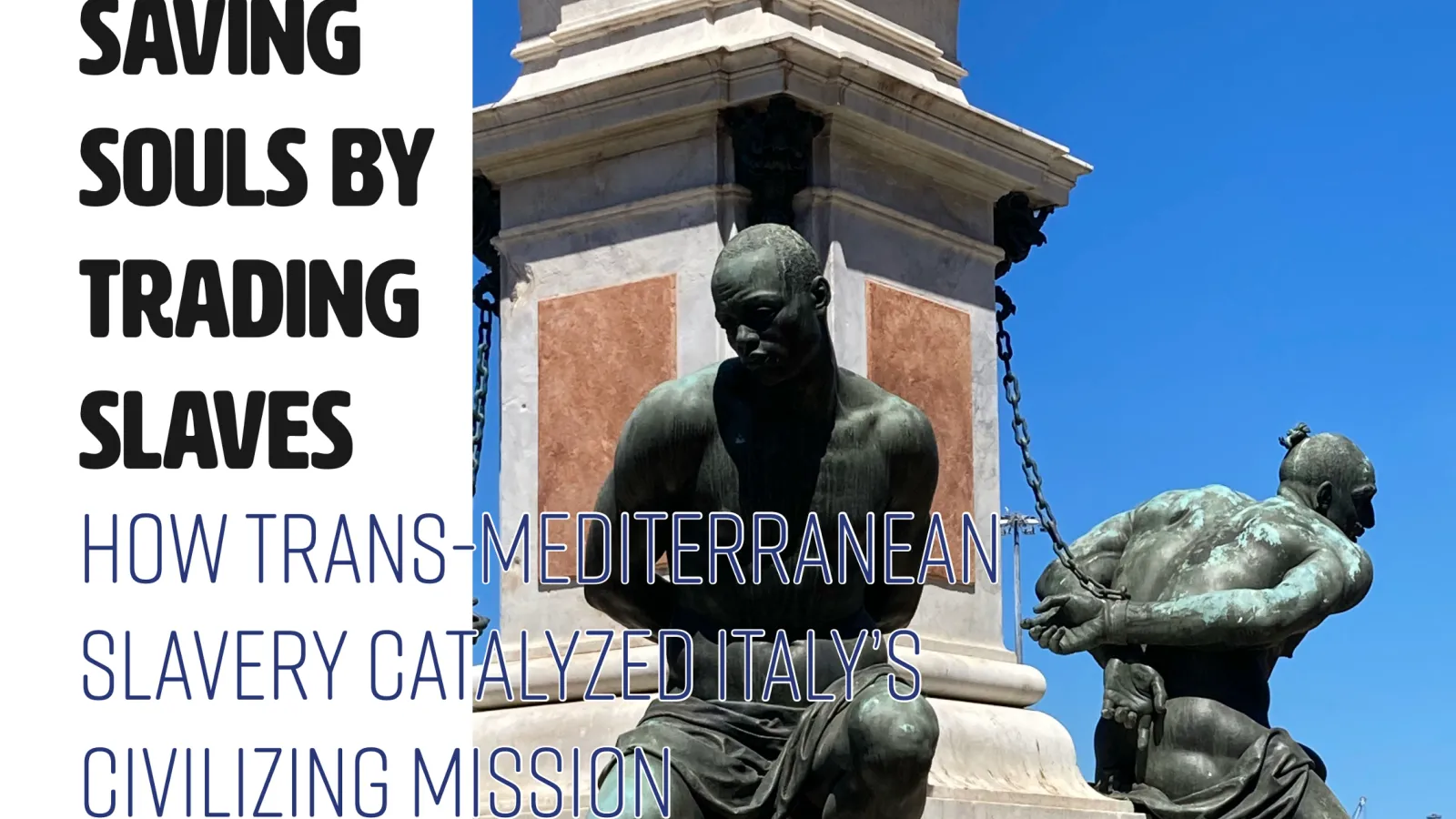
This talk explores the relationship between trans-Mediterranean slavery, which peaked between 1500–1800, and Italian colonial imperialism, which got off the ground shortly after Unification in the nineteenth century. It zeroes in on the work of a Capuchin friar from Genoa, Nicolò Oliveri (1792–1864), who harnessed a vast, centuries-old economic and political network that had once raised money to ransom and release Genoese captives held in Barbary Coast prisons. Oliveri repurposed that network to “rescue” young girls from slavery in Africa, who were then sent to France to be “civilized,” and after which, would return to Africa as missionaries on their own civilizing missions. His was an operation of slave redemption and civilizing mission rolled into one, which preceded the work of Italian colonists in eastern Africa by a little over a decade.
This story traverses slave markets in Egypt, convents in France, palazzi in Genoa, and bagnos (slave prisons) in Algiers, and questions how the Italian experience of slavery served as an important, yet unacknowledged, catalyst for the civilizing mission of Italy’s colonial enterprise. It holds that operations of redemption—to rescue slaves, to civilize natives—connected slavery and colonialism in the modern Italian context. By tracing out the dynamics of this relationship, the larger project, of which this talk is a part, aims to recover a transnational history of slavery in Italy, which despite the central role played by Italian merchants, financiers, and shipbuilders, has been neglected by historiography and erased from Italian public memory: a vanished enterprise that historians estimate trafficked millions of people over the course of three centuries and that which has a still long, unreconciled afterlife in Italy to this day.

Malia Hom is the author of Empire’s Mobius Strip: Historical Echoes in Italy’s Crisis of Migration and Detention (2019) and The Beautiful Country: Tourism and the Impossible State of Destination Italy (2015)