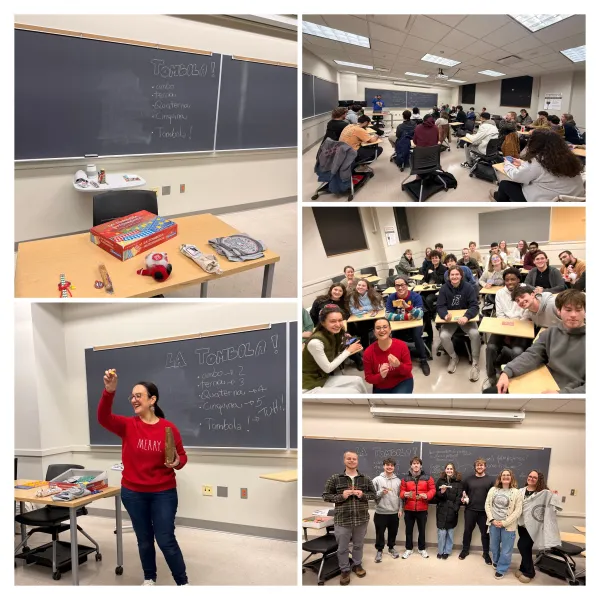
Thanks to the wonderfully generous family of Professor Emeritus Albert N. Mancini, the Department of French and Italian is able to host programming on a variety of Italian language topics. Our undergraduate Italian Club was also able to have a game night featuring Italian film, art, and food. In Autumn 2025, Italian Professor Qian Liu was pleased to curate and host three speakers to share their wisdom and expertise with Ohio State Students in a series entitled New Directions in Italian Studies: Migration and Mobility. When asked about the New Directions series, Professor Liu said:
At the heart of this initiative lies a commitment to exploring how themes of migration, diaspora, and cross-cultural exchange are redefining notions of Italian identity in the 20th and 21st century. The series responds to the broader transnational turn within the field—an intellectual shift that moves beyond the traditional nation-bound frameworks to examine Italy in a global context. For its inaugural season, the series proudly presents three compelling talks by distinguished guests: Giulia Riccò (University of Michigan), Gaoheng Zhang (University of British Columbia), and Ubah Cristina Ali Farah, the renowned Somali-Italian writer and activist.

Migration and Mobility with Giulia Riccò
Our first speaker was Professor Giulia Riccò. Her book, The Italian Colony of São Paulo: Race, Class, and Cultural Capital in Brazil (Fordham University Press, 2025) argues that, contrary to what one might expect, Italians first became racialized as white in São Paulo, Brazil at the turn of the twentieth century. Whereas Italians in the United States struggled with xenophobia and were often not fully acknowledged as white, in São Paulo, due to a series of social, economic, and cultural factors, Italians became closely associated with ideas of whiteness, modernization, and civilization. This book brings to light how the overlooked experiences of Italians in Brazil complicate conventional narratives about the racial ambiguity and oppression of Italians in the Americas, on the one hand, and the conflation of Italians with cultural and economic backwardness in Europe, on the other. We will discuss this book and Professor Giulia Riccò's research more broadly and invite you to be part of the conversation.
Giulia Riccò is an Assistant Professor of Romance Languages and Literatures at the University of Michigan, Ann Arbor. Her research and teaching focus on modern Italian and Brazilian literature and culture, with particular attention to nationalism and migration. She is the author of The Italian Colony of São Paulo: Race, Class, and Cultural Capital in Brazil (Fordham University Press, 2025), part of the Critical Studies in Italian Migrations series and winner of the 2024 MLA Aldo and Jeanne Scaglione Award for a Manuscript in Italian Literary Studies. Her work has appeared in Cultural Dynamics, Forum Italicum, Radical History Review, Literature and (Im)migration in Brazil, Italian Culture, Altreitalie, and Public Books. She currently co-edits the H-Net platform TransItalian Studies and co-chairs the AAIS Critical Race, Migrations, and Diasporas Caucus.

Migration and Mobility with Gaoheng Zhang
Our second speaker was Professor Gaoheng Zhang. His new book, Italian Dumplings and Chinese Pizzas: Transcultural Food Mobilities (Fordham, 2025), addresses China-Italy food cultures against the backdrops of two epoch- making socioeconomic processes. During the 1980s, Chinese cuisine became the first non-European food widely available in Italy, thanks to the widespread presence of Chinese eateries. Only American fast food, which established itself in Italy around the same time, enjoyed comparable popularity as a destination for Italian culinary tourism. Meanwhile, in the early 1990s, together with American hamburgers and fried chicken, the American food chain Pizza Hut’s pizzas and spaghetti were the first non-Asian foods that post-Mao Chinese customers recognized as “Western.” The book proposes a critical framework that analyzes transcultural food mobilities by seriously assessing the confluence of diverse mobilities and their impact on food cultures. Ultimately, the study shows that a sophisticated interpretation of transcultural food mobilities can help address alterity and build understanding in a world of increasing political and cultural polarization. We will discuss this book and Professor Gaoheng Zhang's research more broadly and invite you to be part of the conversation.
Gaoheng Zhang is Associate Professor of Italian Studies at the University of British Columbia. His recent books include three monographs, Italian Dumplings and Chinese Pizzas: Transcultural Food Mobilities(Fordham, 2025), Fashion Communications Between Italy and China: Unfolding a Sartorial Relationship(Bloomsbury, 2025), and Migration and the Media: Debating Chinese Migration to Italy, 1992–2012(Toronto, 2019), and a co-edited volume, Cultural Mobilities Between China and Italy (Palgrave Macmillan, 2024).

Migration and Mobility with Ubah Cristina Ali Farah
Our third speaker was Somali-Italian poet, novelist, playwright, and librettist, Ubah Cristina Ali Farah. Dr. Farah's talk, entitled, The Termite House: Creative Writing, Distance, and My Transatlantic Journey. She grew up in Mogadishu but fled to Europe at the outbreak of the civil war. She is the author of three novels: Little Mother (Madre piccola, Frassinelli, 2007) and Commander of the river (Il comandante del fiume, 66thand2nd, 2014) – both published in English by Indiana University Press as part of the Global African Voices series – and Stations of the Moon (Le stazioni della luna , 66thand2nd, 2021). She also wrote the ekphrasis La danza dell’orice (Juxta Press, 2020) and the collection of short stories The Phoenix’s Ashes (Le ceneri della fenice , Hopefulmonster, 2022). She holds a PhD in African Studies (Università L’Orientale Napoli) and is the recipient of the Lingua Madre and Vittorini Prizes. In her talk, Ubah Cristina Ali Farah will share her transnational literary experiences in Africa, Europe, and the United States.
Italian Club Game Night
Students joined and everyone had so much fun playing Tombola, a traditional Christmas board game in Italy.